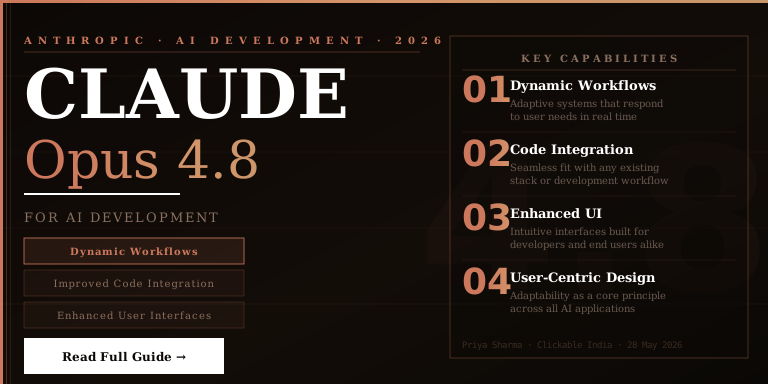
Understanding Claude Opus 4.8: Impact on AI Development
Claude Opus 4.8 represents a significant leap forward in the realm of artificial intelligence, particularly in coding and agentic workflows. This advanced hybrid reasoning model, released on May 28, 2026, is designed to tackle complex tasks with remarkable efficiency and adaptability. Its enhanced capabilities are set to influence various sectors, paving the way for more sophisticated AI applications.
- Claude Opus 4.8 features a 1 million token context window, enabling it to handle extensive data inputs.
- It excels in advanced coding, allowing for production-ready code with minimal human oversight.
- Opus 4.8 is tailored for enterprise workflows, efficiently managing complex, multi-day projects.
- Adaptive thinking capabilities allow the model to adjust its processing based on task complexity.
- The model is accessible through various platforms including AWS, Google Cloud, and Microsoft Foundry.
- Pricing starts at approximately ₹415 per million input tokens and ₹2,075 per million output tokens.
What is Claude Opus 4.8?
Claude Opus 4.8 is the latest iteration of Anthropic's AI models, fundamentally designed to enhance coding and agentic tasks. This model incorporates advanced hybrid reasoning techniques, which enable it to perform complex problem-solving with a high degree of autonomy. The introduction of a 1 million token context window marks a significant upgrade, allowing for a broader understanding of context and information retention over extended interactions.
One of the defining features of Opus 4.8 is its adaptability. The model leverages a unique adaptive thinking capability, which allows it to modulate its cognitive resources based on the complexity of the task at hand. This means that for simpler tasks, it can respond quickly, while for more intricate challenges, it dedicates more processing time to ensure accuracy and thoroughness.
In addition to its coding prowess, Claude Opus 4.8 is built to support agentic workflows, meaning it can orchestrate tasks that require interaction across multiple tools and data sources. This makes it especially valuable in professional environments where multi-step tasks and collaboration are essential.
Why Does Claude Opus 4.8 Matter?
The significance of Claude Opus 4.8 lies in its potential to revolutionize how businesses approach complex problem-solving. With its ability to produce high-quality, production-ready code, organizations can reduce dependency on human engineers for routine tasks. This not only enhances efficiency but also allows skilled developers to focus on more strategic aspects of their work.
Moreover, the model's capabilities extend beyond coding. In high-stakes environments, where precision and reliability are paramount, Opus 4.8 can manage complex enterprise workflows, ensuring that projects are executed seamlessly over extended periods. This level of reliability can lead to significant cost savings and improved outcomes in project management.
Furthermore, as businesses increasingly adopt AI solutions, the introduction of models like Opus 4.8 underscores the importance of advanced AI in maintaining competitive advantages. The ability to streamline operations and improve productivity can be a game changer in fast-paced markets, making it essential for companies to stay abreast of such developments.
Advanced Coding Capabilities
One of the hallmark features of Claude Opus 4.8 is its advanced coding capabilities. The model is designed to generate production-ready code with minimal oversight, significantly reducing the workload for software engineers. This capability is particularly beneficial for organizations that need to deploy complex applications quickly and efficiently.
Opus 4.8 employs rigorous planning and execution strategies, allowing it to navigate large codebases effectively. It is capable of not only writing code but also catching its own mistakes, thus enhancing the reliability of the output. This self-correcting feature means that senior engineers can confidently delegate challenging coding tasks to the model, knowing that it will maintain a high standard of quality.
| Feature | Description |
|---|---|
| Production-Ready Code | Delivers high-quality code efficient for deployment. |
| Error Detection | Catches and corrects its own mistakes autonomously. |
| Large Codebase Management | Effectively navigates and manages extensive codebases. |
| Minimal Oversight | Reduces the need for constant human monitoring. |
Agentic Workflows
Claude Opus 4.8 is not just about coding; it also excels in managing agentic workflows. This aspect allows the model to orchestrate complex tasks that require collaboration across various tools and systems. In environments where multiple applications are used simultaneously, Opus 4.8 can coordinate these interactions, ensuring that workflows progress smoothly.
The model's ability to carry context across sessions means it can maintain continuity in ongoing projects, which is crucial for tasks that span multiple days. This feature allows it to learn from previous interactions, making it more effective at handling long-term projects without losing track of details.
In terms of practical applications, Opus 4.8 can be employed in scenarios such as project management, where it can oversee the execution of tasks, track deadlines, and ensure that all components of a project are aligned. This level of orchestration can lead to significant improvements in productivity and project success rates.
| Aspect | Description |
|---|---|
| Contextual Awareness | Maintains context across multiple sessions for better task management. |
| Multi-Tool Interaction | Coordinates tasks across different applications seamlessly. |
| Long-Term Project Management | Effectively manages projects that require sustained effort over time. |
Enterprise Workflows
Another core aspect of Claude Opus 4.8 is its optimization for enterprise workflows. The model is specifically designed to handle high-stakes tasks that require precision and reliability. By leveraging its capabilities, organizations can ensure that their workflows are not only efficient but also effective in achieving desired outcomes.
Opus 4.8's ability to manage complex projects allows businesses to streamline operations, thereby reducing the time and resources needed to complete tasks. This is particularly beneficial in industries where timely delivery is critical, such as software development and finance.
Furthermore, the model's pricing structure, starting at approximately ₹415 per million input tokens and ₹2,075 per million output tokens, makes it a viable option for businesses looking to integrate advanced AI solutions into their operations. The potential for cost savings through prompt caching and batch processing adds another layer of value for organizations considering its implementation.
| Pricing Tier | Input Tokens (INR) | Output Tokens (INR) |
|---|---|---|
| Basic | ₹415 | ₹2,075 |
| Pro | ₹1,415 | ₹6,075 |
| Enterprise | Custom pricing | Custom pricing |
India Perspective
In India, the potential applications of Claude Opus 4.8 are vast, particularly in the burgeoning tech industry. As Indian startups and established companies alike seek to enhance their operational efficiency, the integration of advanced AI models like Opus 4.8 can provide a competitive edge. The pricing structure is also conducive to Indian businesses, allowing them to access cutting-edge technology at relatively affordable rates.
Additionally, the Indian regulatory landscape is evolving to accommodate AI technologies. As businesses adopt these tools, they must also navigate data privacy laws and compliance requirements, making it essential for companies to stay informed about regulatory changes. This is particularly relevant for industries such as finance and healthcare, where data security is paramount.
Moreover, Indian educational institutions and tech hubs can leverage Claude Opus 4.8 for research and development, fostering innovation within the country. By incorporating such advanced AI models into academic curricula and entrepreneurial projects, India can enhance its position as a global leader in technology and AI development.
Common Mistakes
- Overestimating AI Capabilities: Many users may expect AI to solve all problems without human input, leading to disappointment. It's crucial to understand that while models like Opus 4.8 are powerful, they still require oversight.
- Neglecting Data Privacy: In the rush to implement AI solutions, businesses might overlook data security regulations, resulting in compliance issues. Companies must prioritize understanding and adhering to local data laws.
- Inadequate Training: Failing to properly train employees on how to use AI tools can hinder their effectiveness. Organizations should invest in comprehensive training programs to maximize the benefits of AI.
- Ignoring Contextual Limitations: Users may misinterpret AI outputs without considering the context in which the model operates. Understanding the limitations of the model’s context window is essential for accurate application.
- Underutilizing Features: Many users may not explore all available features of AI models, leading to suboptimal use. Businesses should fully explore the capabilities of Opus 4.8 to leverage its full potential.
Frequently Asked Questions
What is Claude Opus 4.8?
How does Claude Opus 4.8 improve coding tasks?
What are the pricing details for using Claude Opus 4.8?
How can businesses in India benefit from Claude Opus 4.8?
Stay Updated
Get the latest posts delivered to your inbox.
Related Posts
Is This How We'll Build Websites Soon? Exploring webMCP Live Demo
Discover how webMCP is set to revolutionize website development and AI integration in 2026. Explore its features and...
Exploring New Methods for Desalination in 2026
Learn about innovative desalination methods transforming ocean water into drinking water, addressing global water...