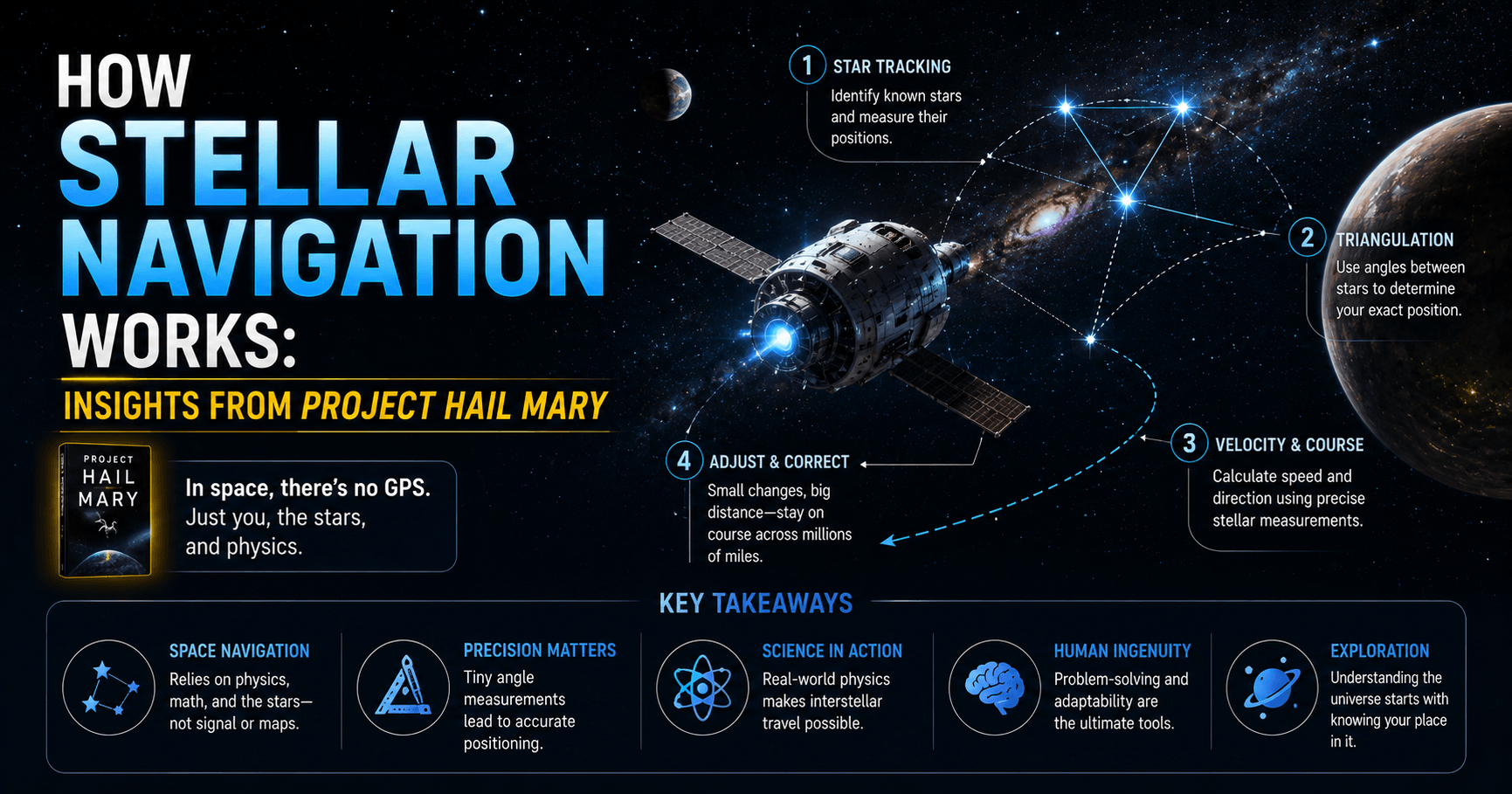
How Stellar Navigation Works: Insights from Project Hail Mary
Understanding Stellar Navigation
Stellar navigation is a method of determining one's position and course by observing the stars. This ancient practice has evolved into a sophisticated technique used in modern space exploration, particularly in scenarios where conventional GPS signals are unavailable, such as deep space missions. In Andy Weir's Project Hail Mary, the protagonist utilizes stellar navigation to guide his spacecraft across vast interstellar distances.
The concept of stellar navigation is grounded in the principles of astrometry, the branch of astronomy that involves measuring the positions and movements of celestial bodies. By understanding the fixed positions of stars and their apparent movements due to the observer's motion, navigators can determine their spacecraft's location and orientation in space. This method is not only critical for interstellar travel but also reflects foundational principles of navigation that date back to ancient mariners who relied on the night sky to find their way.
In Project Hail Mary, the protagonist employs a combination of celestial observations and mathematical calculations to chart a course toward a distant solar system. This highlights the importance of understanding stellar patterns and the relative positions of stars, which can serve as reference points for navigation in the void of space. Thus, stellar navigation remains an indispensable aspect of traversing the cosmos.
- Stellar navigation relies on the observation of stars to determine position and course.
- It uses principles of astrometry to navigate in environments where GPS is unavailable.
- Project Hail Mary illustrates practical applications of stellar navigation in interstellar travel.
- Understanding stellar navigation is crucial for future space exploration missions.
- The method is rooted in ancient navigation practices used by mariners.
Why Does Stellar Navigation Matter?
The significance of stellar navigation extends beyond mere theoretical interest; it is vital for the success of current and future space missions. As humanity ventures further into space, reliable navigation systems become paramount. Stellar navigation provides an alternative to terrestrial GPS, which becomes ineffective beyond low Earth orbit. For instance, missions to Mars or beyond require methods that can function independently of Earth-based systems, making stellar navigation essential.
Moreover, as we explore deeper into the universe, the potential for encountering unknown celestial phenomena increases. Stellar navigation systems can adapt to new environments, as they rely on the consistent positions of stars, which serve as universal reference points. This adaptability is crucial for navigating the unpredictable expanses of space, where traditional methods may fail.
Additionally, the reliance on stellar navigation fosters advancements in technology and science. The need for accurate navigation in space has driven innovations in telescopes, sensors, and computational algorithms. These technologies not only benefit space exploration but also find applications in various fields on Earth, such as aviation and maritime industries, enhancing safety and efficiency.
The Mechanics of Stellar Navigation
Stellar navigation involves several key components, including celestial bodies, instruments for observation, and mathematical calculations. Celestial bodies—primarily stars—serve as the primary reference points for navigation. Their positions in the sky can be measured using instruments like telescopes and astrolabes, which allow navigators to determine their angle relative to the horizon.
One of the fundamental techniques used in stellar navigation is triangulation. By measuring the angles to at least two known stars, navigators can form a triangle with their spacecraft's position at one vertex. This mathematical approach allows for precise location determination, as the intersection of the lines drawn from the observed angles reveals the spacecraft's position. For example, if a navigator measures the angles to Alpha Centauri and Betelgeuse, they can calculate their exact location in space.
| Component | Description |
|---|---|
| Celestial Bodies | Stars and other celestial objects used as reference points. |
| Instruments | Telescopes and astrolabes used for measuring angles. |
| Mathematical Calculations | Triangulation and other methods to determine position. |
This method's importance is illustrated in Project Hail Mary, where the protagonist must navigate through complex star fields to reach their destination. The effectiveness of stellar navigation relies on the accuracy of the measurements and the navigators' understanding of celestial mechanics, which defines how celestial bodies move and interact.
Technological Advances in Stellar Navigation
Recent developments in technology have significantly enhanced the capabilities of stellar navigation. Modern spacecraft are equipped with advanced sensors and software that improve the precision of celestial observations. For instance, star trackers can automatically identify and follow stars, providing real-time data on their positions relative to the spacecraft.
Furthermore, the integration of artificial intelligence and machine learning into navigation systems has the potential to revolutionize stellar navigation. These technologies can analyze vast amounts of data from celestial observations and make real-time adjustments to navigation calculations. This capability is crucial for missions that require autonomous navigation, allowing spacecraft to adapt to changing conditions without human intervention.
In addition, the development of new algorithms for celestial navigation enhances the accuracy of position determination. For example, some algorithms can account for gravitational influences from nearby celestial bodies, providing a more nuanced understanding of the spacecraft's trajectory. This level of precision is essential for missions that aim to rendezvous with other spacecraft or land on distant planets.
| Advancement | Description |
|---|---|
| Star Trackers | Automated systems for identifying and tracking stars. |
| AI Integration | Use of machine learning for real-time navigation adjustments. |
| Advanced Algorithms | New calculations accounting for gravitational influences. |
India Perspective on Stellar Navigation
India has made significant strides in space exploration, with its space agency, ISRO (Indian Space Research Organisation), actively participating in various interplanetary missions. Understanding stellar navigation is crucial for India's ambitions in deep space exploration, particularly as it plans future missions to Mars and beyond. The Indian Mars Orbiter Mission (Mangalyaan) showcased India's capabilities in space navigation, utilizing a combination of Earth-based and celestial observations to successfully reach Mars.
In terms of costs, developing stellar navigation systems can be financially demanding, but it is essential for the long-term success of space missions. The Indian government has been investing in space technology, and while specific costs for stellar navigation systems are not disclosed, the overall budget for ISRO's ambitious plans indicates a commitment to enhancing navigation capabilities. As of 2021, India's space budget was approximately ₹13,479 crores, reflecting a growing investment in advanced technologies, including navigation.
Moreover, India's growing space industry includes collaborations with private companies and international partners, which can lead to innovations in navigation technologies. Companies like Bharti Airtel and Reliance Industries are exploring opportunities to support space ventures, potentially contributing to advancements in stellar navigation. This collaborative approach can enhance India's capabilities in navigating the challenges of interstellar travel.
Common Mistakes in Stellar Navigation
- Over-reliance on GPS: Many navigators mistakenly believe that GPS will always be available, overlooking the importance of traditional methods like stellar navigation, especially in deep space.
- Ignoring celestial mechanics: Failing to understand the movements of celestial bodies can lead to significant errors in navigation calculations, resulting in miscalculations of position.
- Inadequate training: Underestimating the complexity of stellar navigation can lead to insufficient training for navigators, diminishing their ability to use these techniques effectively.
- Neglecting technological advancements: Some navigators may stick to outdated methods, ignoring new technologies that can enhance the accuracy of stellar navigation.
- Failure to account for environmental factors: Not considering factors such as gravitational influences from nearby bodies can result in inaccurate navigation outcomes and potentially jeopardize missions.
Frequently Asked Questions
What is stellar navigation?
How does stellar navigation work?
Why is stellar navigation important for space travel?
What technologies enhance stellar navigation?
Stay Updated
Get the latest posts delivered to your inbox.
Related Posts
Is This How We'll Build Websites Soon? Exploring webMCP Live Demo
Discover how webMCP is set to revolutionize website development and AI integration in 2026. Explore its features and...
5 High Paying Tech Jobs for Freshers in 2026
Explore the top five high-paying tech jobs for freshers in 2026, including salary insights and industry demand.