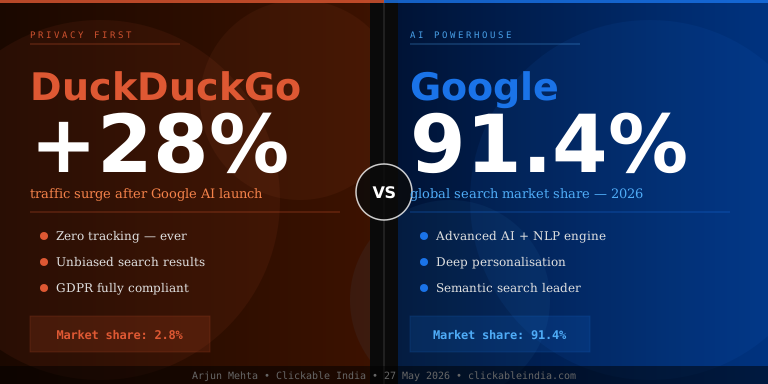
The Rise of AI in Search: DuckDuckGo vs Google
Opening
The rise of artificial intelligence (AI) in search engines has significantly transformed how users access information, with profound implications for both privacy and personalization. Major players like Google and DuckDuckGo exemplify two contrasting approaches: Google leverages AI to optimize search results and enhance user engagement through personalization, while DuckDuckGo emphasizes user privacy without sacrificing functionality. Understanding these differences is crucial for users as they navigate their options in the digital landscape.
- AI enhances search engine capabilities by improving accuracy and personalization, leading to more relevant results.
- Google uses AI to analyze user behavior for tailored results, but this often comes at the cost of user privacy.
- DuckDuckGo prioritizes user privacy while employing AI for basic search functionalities, appealing to privacy-conscious users.
- The choice between these platforms reflects user values regarding privacy and personalization in the context of increasing data awareness.
- Understanding AI's role in search can help users make informed choices about their preferred search engine, especially in India.
What is AI in Search?
AI in search refers to the integration of artificial intelligence technologies to enhance the retrieval and ranking of information from the vast expanse of the internet. This integration involves algorithms that analyze user queries, behavior, and preferences to provide more relevant results. For instance, AI can understand the context behind a user's search, making it possible to deliver results that align closely with their intentions. In 2023, it was estimated that over 3.5 billion searches are conducted on Google every day, showcasing the scale at which AI is employed to manage and optimize these queries.
Search engines like Google and DuckDuckGo utilize various AI technologies, including natural language processing (NLP) and machine learning (ML), to interpret user queries more effectively. NLP enables search engines to understand the nuances of human language, while ML helps in continuously improving search algorithms based on user interactions. For example, Google’s algorithms learn from billions of searches to refine their understanding of language and context, which is essential for delivering accurate results. In India, where the internet user base is projected to reach 900 million by 2025, the role of AI in search becomes increasingly vital to cater to diverse linguistic and cultural contexts.
The rise of AI in search is significant because it enhances the user experience by making information retrieval faster and more relevant. Users today expect search engines to not only provide answers but also to anticipate their needs based on prior interactions. This shift in user expectations has pushed search engines to innovate continually, leading to the sophisticated AI-driven systems we see today. With the increasing reliance on mobile devices in India, where over 70% of internet users access the web via smartphones, the demand for efficient and effective search solutions powered by AI is higher than ever.
Why Does AI in Search Matter?
AI in search matters primarily due to its transformative impact on how users find information online. With a staggering amount of content available—estimated at over 1.8 billion websites—AI helps filter and prioritize data, ensuring that users receive accurate and relevant results. This capability is particularly important in the age of information overload, where users can easily become overwhelmed by the sheer volume of available information. In India, where the digital landscape is rapidly evolving, AI-driven search technologies are crucial for navigating the vast array of online content.
Moreover, the implementation of AI in search engines can lead to enhanced user engagement and satisfaction. For instance, when users receive results that closely match their search intent, they are more likely to return to the platform for future queries. This cycle of engagement is crucial for search engines, as it directly influences their traffic and revenue models. In India, where digital advertising spending is expected to reach ₹25,000 crores by 2025, businesses that leverage AI for search optimization can see significant benefits in customer retention and conversion rates.
Finally, AI's role in search has broader implications for privacy and data security. As search engines collect data to improve their services, concerns about user privacy emerge. In India, the Personal Data Protection Bill aims to address these concerns by establishing guidelines for data collection and usage. Understanding how AI operates in this context enables users to make informed choices about the platforms they use, balancing the benefits of personalized search against the potential risks to their privacy. With increasing awareness of data privacy issues, users are more inclined to consider how their information is managed by search engines.
Google's Approach to AI in Search
Google employs AI extensively to enhance its search functionalities, focusing on personalization and user engagement. One significant aspect of Google's AI strategy is its use of machine learning algorithms, which analyze user behavior to tailor search results. For example, Google can learn from previous searches to predict what a user might be looking for in future queries. This personalized experience is reflected in the fact that approximately 70% of users are more likely to click on a result that aligns with their past behavior.
Additionally, Google's RankBrain is a notable AI component that helps process search queries by interpreting the intent behind them. This technology enables Google to deliver more relevant results, even for ambiguous queries. For instance, a user searching for "best restaurants" may receive personalized suggestions based on their past searches and location. In India, where local cuisine is diverse, this feature can significantly enhance user experience by providing tailored recommendations based on regional preferences.
| Feature | Google's Approach |
|---|---|
| Personalization | Utilizes machine learning to tailor results based on user behavior. |
| Understanding Queries | Employs RankBrain to interpret search intent and deliver relevant outcomes. |
| Engagement | Focuses on user interaction to improve future search experiences. |
However, this extensive use of AI has raised valid concerns regarding user privacy. Google collects vast amounts of data to enhance its services, leading to debates about the extent to which user information is protected. For instance, a 2022 survey revealed that 92% of users are concerned about how their data is used by search engines. In India, where the government is actively working on data protection regulations, users must weigh the benefits of personalized search against potential privacy infringements. This growing awareness of data privacy issues is prompting many users to consider alternatives like DuckDuckGo.
DuckDuckGo's Approach to AI in Search
In contrast to Google, DuckDuckGo adopts a different philosophy regarding AI in search, prioritizing user privacy over personalization. DuckDuckGo does not track users or collect personal data, making it a preferred choice for privacy-conscious individuals. While it employs AI for basic functionalities, such as providing relevant search results, its approach is fundamentally different from Google's data-driven model. In recent years, DuckDuckGo has reported a steady increase in user adoption, with its daily search queries surpassing 100 million in early 2023, reflecting a growing demand for privacy-first search solutions.
DuckDuckGo's AI capabilities focus on delivering accurate search results without compromising user privacy. It utilizes various algorithms to interpret queries and return relevant links, but it does so without building user profiles based on search history. For instance, when users search for "best coffee shops," DuckDuckGo provides results based on the query itself rather than personalized data. This approach resonates with users who prioritize privacy over tailored experiences, especially in regions like India, where awareness of data privacy is increasing.
| Feature | DuckDuckGo's Approach |
|---|---|
| Privacy | Does not track user behavior or collect personal information. |
| Search Results | Relies on algorithms to deliver relevant outcomes without personalization. |
| User Engagement | Focuses on providing accurate results without compromising privacy. |
This commitment to privacy has positioned DuckDuckGo as a viable alternative for users who are concerned about data tracking. As privacy awareness rises, especially among Indian users, DuckDuckGo's model provides a refreshing alternative to traditional search engines. The choice between Google and DuckDuckGo reflects broader societal trends, as individuals become increasingly aware of the implications of data collection and usage.
Comparative Analysis: Google vs. DuckDuckGo
When comparing Google and DuckDuckGo, the key differences lie in their approaches to AI, data collection, and user engagement. Google leverages extensive data to enhance personalization, while DuckDuckGo emphasizes user privacy without personalized tracking. This fundamental distinction influences user experience, search results, and overall engagement. In India, where the digital landscape is rapidly evolving, users are increasingly seeking platforms that align with their values regarding privacy and data security.
Users seeking personalized search experiences may find Google's platform more appealing due to its ability to deliver tailored results based on past behavior and preferences. In contrast, those who prioritize privacy may prefer DuckDuckGo for its commitment to not tracking user data. This choice reflects broader societal trends in user preferences, as individuals become increasingly aware of data privacy issues. A report from the Internet and Mobile Association of India (IAMAI) states that 53% of Indian internet users are concerned about their online privacy, highlighting the growing demand for privacy-centric solutions.
Ultimately, the decision between Google and DuckDuckGo boils down to personal values regarding privacy and usability. Users must consider their priorities when selecting a search engine, understanding that each platform offers distinct advantages and disadvantages. As India continues to expand its digital footprint, the conversation around privacy and AI in search will only become more prominent, influencing user choices and shaping the future of search engines in the country.
India Perspective
The impact of AI in search is also relevant in the Indian context, as internet usage continues to grow rapidly. With millions of users relying on search engines for information, the choices between Google and DuckDuckGo become significant. Google is the dominant search engine in India, leveraging its advanced AI capabilities to provide personalized results that cater to diverse user needs. According to a report by IAMAI, Google holds over 90% of the search engine market share in India, underscoring its widespread adoption.
However, as privacy concerns rise in India, DuckDuckGo’s model presents an appealing alternative for users who wish to maintain anonymity while searching. The Indian market is increasingly aware of data privacy issues, and this awareness is reflected in the growing interest in platforms that prioritize user security. DuckDuckGo's emphasis on not tracking users aligns well with these emerging values, attracting users who are wary of data collection practices by larger platforms.
Moreover, the Indian regulatory landscape is evolving, with increasing scrutiny on data protection and user privacy. The Personal Data Protection Bill aims to establish guidelines for data collection and usage, which could significantly impact how search engines operate in the country. As a result, DuckDuckGo's approach may gain traction among Indian users who are concerned about data privacy. With the government actively working on regulations to protect user data, the demand for privacy-centric search solutions is likely to grow.
Common Mistakes
- Assuming All Search Engines Are Alike: Many users mistakenly believe that all search engines operate similarly. Understanding the distinct philosophies of platforms like Google and DuckDuckGo is crucial for making informed choices.
- Neglecting Privacy Concerns: Users often overlook the implications of data collection by search engines. It's essential to recognize how personal data is utilized and the potential risks involved.
- Focusing Solely on Performance: While speed and accuracy are important, users should also consider privacy features when selecting a search engine. Balancing performance with privacy can lead to better choices.
- Overlooking Local Context: Users may not consider how search engines tailor results based on regional preferences. Understanding local context can enhance the relevance of search results.
- Not Staying Informed: The rapidly evolving landscape of search technology warrants staying updated on changes and advancements. Users should regularly educate themselves about various platforms to make informed decisions.
Frequently Asked Questions
What is the role of AI in search engines?
How does Google use AI for search?
What is DuckDuckGo's approach to AI?
Why choose DuckDuckGo over Google?
Stay Updated
Get the latest posts delivered to your inbox.
Related Posts
Is This How We'll Build Websites Soon? Exploring webMCP Live Demo
Discover how webMCP is set to revolutionize website development and AI integration in 2026. Explore its features and...
5 High Paying Tech Jobs for Freshers in 2026
Explore the top five high-paying tech jobs for freshers in 2026, including salary insights and industry demand.