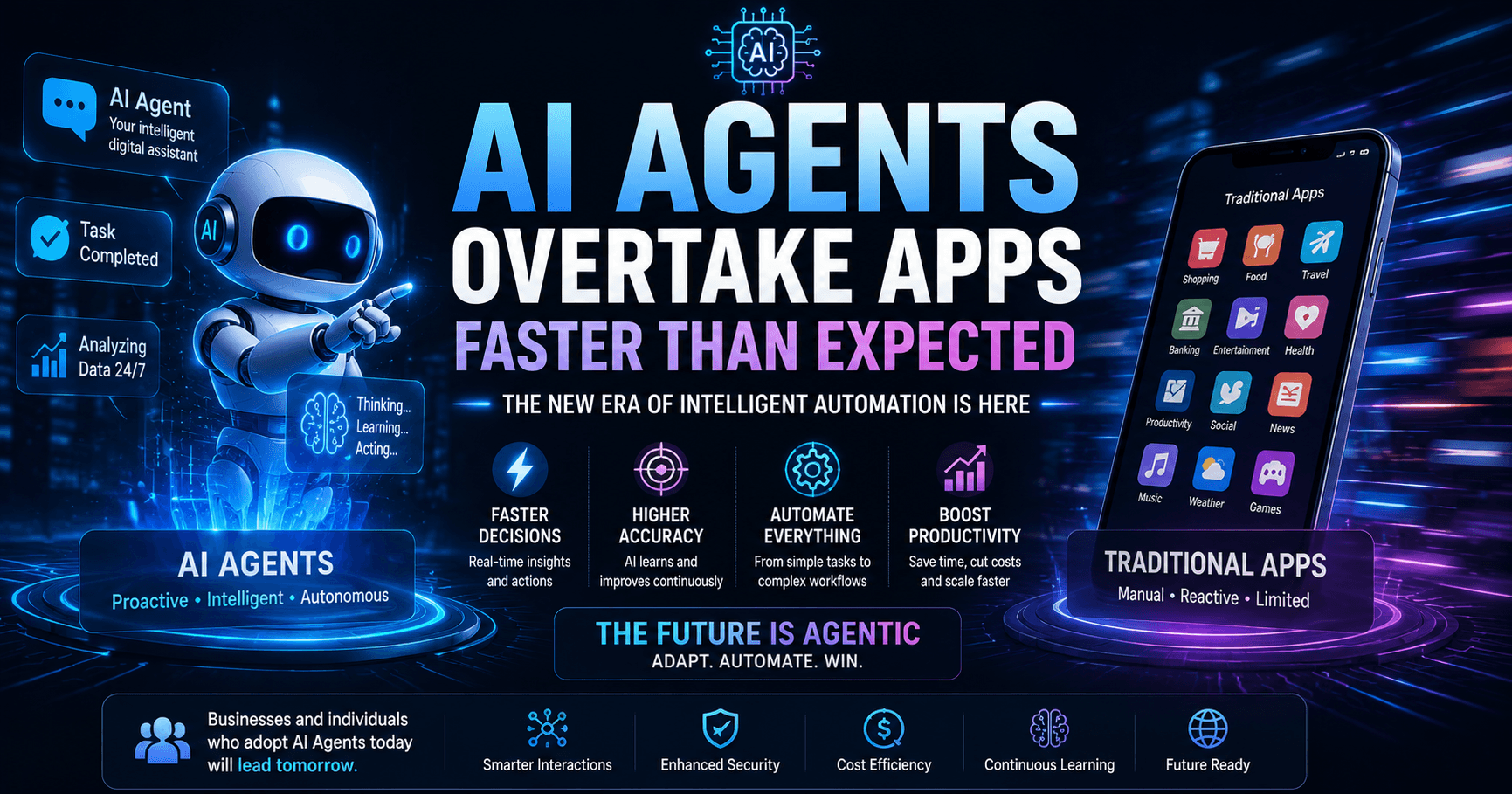
AI Agents Overtake Apps Faster Than Expected
AI Agents Overtake Apps Faster Than Expected
AI agents are emerging as powerful tools that are outpacing traditional applications in various sectors. This trend is reshaping user interactions and expectations, offering more personalized and efficient solutions. As AI technology continues to evolve, its integration into daily tasks is becoming increasingly prevalent.
- AI agents provide more personalized user experiences than traditional apps.
- The evolution of AI is driving rapid adoption across various industries.
- AI agents can automate complex tasks, improving efficiency and productivity.
- Integration of AI agents into workflows is changing job landscapes.
- Understanding AI's implications helps businesses leverage its full potential.
What are AI Agents?
AI agents are advanced software programs designed to perform tasks autonomously by utilizing artificial intelligence techniques. Unlike traditional applications that require user input for each action, AI agents can analyze data, learn from interactions, and make decisions to achieve specific goals. This ability to operate independently makes them suitable for a wide range of applications, from virtual assistants to customer service bots.
These agents leverage machine learning, natural language processing, and other AI technologies to enhance their capabilities. They can engage in conversations, understand context, and adapt to user preferences, making them more intuitive than conventional applications. For example, AI agents can provide recommendations based on past behavior, automate repetitive tasks, and even predict user needs.
The rise of AI agents is also fueled by advancements in computing power and data availability. As machine learning algorithms become more sophisticated, the potential for AI agents to take on complex tasks increases significantly. This shift marks a departure from traditional app models, where user engagement is primarily manual.
Why Do AI Agents Matter?
AI agents are essential as they significantly enhance user experiences across various sectors. By automating routine tasks, they free up time for individuals to focus on more complex and creative endeavors. This shift in workload can lead to increased productivity and higher satisfaction levels among users, as they spend less time on mundane activities.
Moreover, AI agents can offer personalized interactions, tailoring their responses based on individual preferences and behaviors. This personalization fosters a deeper connection between users and technology, resulting in a more engaging experience. For instance, AI-driven recommendation systems can suggest products or services that align with a user’s interests, leading to higher conversion rates for businesses.
Additionally, the integration of AI agents within organizational workflows has the potential to revolutionize industries. They can streamline processes, reduce operational costs, and enhance decision-making capabilities. As businesses increasingly adopt AI technologies, understanding the implications of these changes becomes crucial for staying competitive in the market.
Automation and Efficiency
One of the core advantages of AI agents is their ability to automate complex tasks, leading to increased efficiency in various domains. For instance, in customer service, AI agents can handle inquiries, resolve issues, and provide support without human intervention. This capability not only reduces response times but also allows human agents to focus on more challenging tasks that require human empathy and understanding.
Furthermore, AI agents can analyze vast amounts of data in real-time, identifying patterns and trends that would be impossible for humans to discern quickly. This analytical power enables businesses to make informed decisions based on data-driven insights, ultimately improving their service offerings. Here’s a comparison of traditional apps versus AI agents in terms of automation:
| Feature | Traditional Apps | AI Agents |
|---|---|---|
| Task Automation | Limited automation capabilities | Automates complex tasks autonomously |
| User Interaction | Requires manual input | Adapts to user behavior |
| Decision Making | Static responses | Dynamic and data-driven |
As a result, organizations that implement AI agents can achieve significant cost savings and improved efficiency, allowing them to allocate resources more effectively.
Impact on Employment
While the rise of AI agents presents numerous advantages, it also raises concerns regarding employment and job displacement. The automation of tasks traditionally performed by humans can lead to significant shifts in job roles and responsibilities. As AI agents take over routine tasks, employees may need to upskill or transition into new roles that require more complex problem-solving and interpersonal skills.
However, the emergence of AI agents can also create new job opportunities. For instance, roles focused on AI training, development, and maintenance are becoming increasingly relevant. Organizations will require professionals who can manage AI systems and ensure their alignment with business objectives. Thus, while some jobs may be displaced, the AI revolution also necessitates a shift in skills and education.
Here’s a summary of potential impacts on employment due to AI agents:
| Impact | Description |
|---|---|
| Job Displacement | Automation may replace routine jobs |
| Job Creation | New roles in AI oversight and management |
| Skills Shift | Increased demand for advanced skills |
Understanding these dynamics is essential for both individuals and organizations to navigate the changing employment landscape effectively.
India Perspective
In India, the rapid adoption of AI agents is transforming various sectors, from customer service to healthcare. As businesses increasingly turn to AI for efficiency and cost reduction, the demand for skilled professionals in AI and machine learning is on the rise. This is reflected in the growing number of educational institutions offering specialized courses in AI, machine learning, and data science.
Furthermore, Indian startups are also leveraging AI technology to develop innovative solutions tailored to the local market. For instance, companies are creating AI-driven chatbots that cater specifically to Indian languages and cultural nuances, enhancing accessibility for diverse user groups. As the Indian economy continues to digitize, the role of AI agents is expected to expand significantly.
Regarding costs, the implementation of AI technology can vary widely depending on the scale and scope of the project. Businesses should consider potential investments in AI infrastructure and training, which could range from a few lakhs to several crores INR. However, the long-term benefits of increased efficiency and productivity often outweigh the initial costs.
Common Mistakes
- Underestimating Implementation Costs: Many businesses fail to account for the full range of costs associated with AI integration, including training and infrastructure.
- Neglecting User Experience: Focusing solely on automation can lead to a poor user experience; it’s essential to balance efficiency with user satisfaction.
- Overlooking Data Privacy: Organizations must prioritize data privacy and security when implementing AI agents to maintain user trust.
- Ignoring Employee Training: As AI agents take over tasks, businesses should invest in training employees to adapt to new roles and technologies.
- Failing to Monitor Performance: Continuous evaluation of AI agents' performance is crucial for ensuring their effectiveness and relevance to business needs.
Frequently Asked Questions
What are AI agents?
How do AI agents differ from traditional apps?
What impact do AI agents have on employment?
How is India adopting AI agents?
Stay Updated
Get the latest posts delivered to your inbox.
Related Posts
Is This How We'll Build Websites Soon? Exploring webMCP Live Demo
Discover how webMCP is set to revolutionize website development and AI integration in 2026. Explore its features and...
5 High Paying Tech Jobs for Freshers in 2026
Explore the top five high-paying tech jobs for freshers in 2026, including salary insights and industry demand.